
Understanding Foreign Exchange Reserves

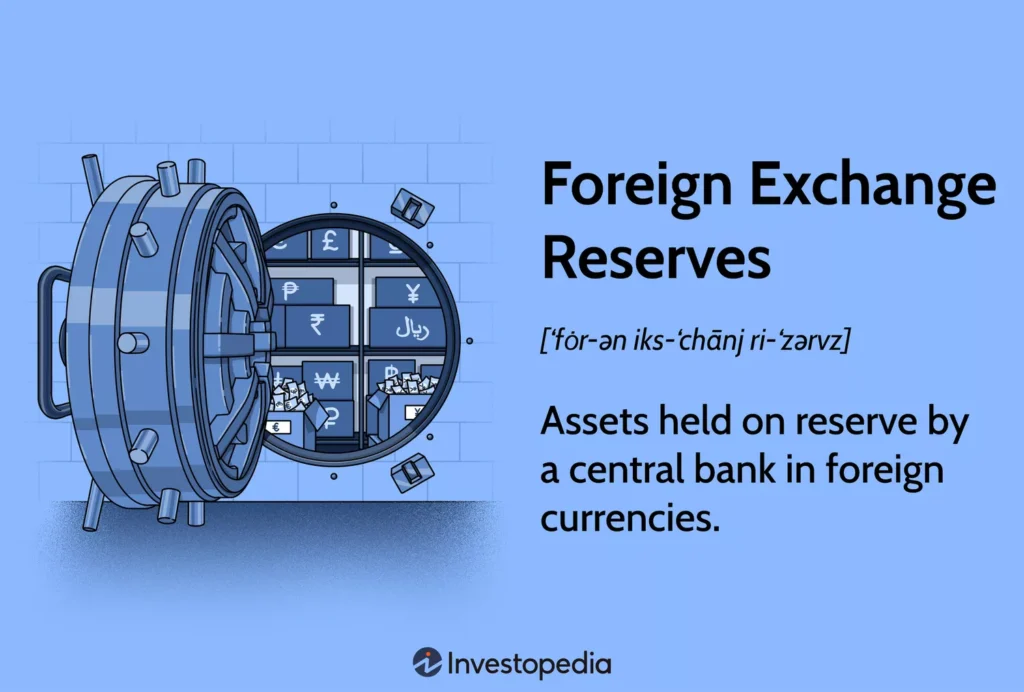
Foreign exchange reserves are assets held by a central bank, denominated in a foreign currency. These reserves serve multiple purposes, primarily to back liabilities and influence monetary policy. They can include banknotes, deposits, bonds, treasury bills, and other government securities.
Key Takeaways:


– Foreign exchange reserves are held by a nation’s central bank in foreign currencies.


– They may consist of foreign currencies, bonds, treasury bills, and other government securities.


– Most reserves are held in U.S. dollars, with China being the largest holder globally.


– Economists recommend holding reserves in currencies not directly linked to the country’s own currency.


How Foreign Exchange Reserves Work:


Central banks worldwide commonly hold significant reserves in foreign exchange. Predominantly, these are in U.S. dollars, given its status as the world’s most traded currency. Other currencies such as the British pound (GBP), the euro (EUR), the Chinese yuan (CNY), and the Japanese yen (JPY) are also included.


Economists stress the importance of holding foreign exchange reserves in a currency not directly connected to a country’s own to provide a buffer against market shocks. However, this has become challenging as global trading has made currencies increasingly intertwined.


Foreign exchange reserves are not just for backing liabilities but also play a role in shaping monetary policy.


Example of Foreign Exchange Reserves:


The world’s largest holder of foreign exchange reserves is China, with over $3 trillion in foreign currency assets. Most of these are held in U.S. dollars, facilitating international trade predominantly conducted in U.S. dollars.


Saudi Arabia also maintains substantial foreign exchange reserves, relying heavily on oil exports. Large reserves act as a cushion against potential oil price drops.


As of the last week of July 2024, U.S. foreign exchange reserves totaled over $244 billion.


Russia’s reserves, predominantly in U.S. dollars like many others, also include gold. Gold’s underlying value poses a risk as it may not sufficiently support the country in the event of an economic downturn.


How Much in U.S. Treasuries Does China Hold?
As of May 2024, China held $768.3 billion in U.S. Treasury securities, making it the second-largest foreign holder of U.S. debt after Japan.8

Who Has the Largest Foreign Exchange Reserves in the World?
According to an analysis of foreign exchange reserves, China has the largest foreign exchange reserve in the world, holding over $3.6 trillion. Japan came in second, holding $1.


3 trillion, and Switzerland followed with $890 billion.

How Much Money Total Is Held in Foreign Exchange Reserve?
According to the latest available data, the total value of all foreign exchange reserves equaled nearly $12.35 trillion dollars in the first quarter of 2024.9 That number represents a slight increase from the same period in 2023.

As of February 2022, Russia’s foreign exchange reserves totaled some $630 billion.


6 However, sanctions imposed by the European Union (EU), the U.S., and other nations in response to Russia’s invasion of Ukraine in February 2022 rendered most of those reserves inaccessible to the central bank.

Another danger of using gold as a reserve is that the asset is only worth what someone else is willing to pay for it. During an economic crash, that would put the power of determining the value of the gold reserve, and therefore Russia’s financial fallback, into the hands of the entity willing to purchase it.


The Bottom Line
Foreign exchange reserves are foreign-denominated assets held by a central bank for the purpose of backing liabilities and influencing monetary policy.
Foreign exchange reserves can take many forms, including cash and bonds. They can provide a buffer in times of crisis, should a country’s own currency lose value.
China currently holds the world’s biggest foreign exchange reserve.




Leave a Comment

Your email address will not be published. Required fields are marked *